


In the first quarter of 2009, with the world reeling from a global financial meltdown and entire nations declaring bankruptcy, the world’s largest oil companies (Big Oil) were reeling in some of their largest quarterly profits ever. The real irony is that while terms like “sub-prime mortgage” and “credit” crisis were being bandied about, this colossal collapse was being induced by the very same Big Oil and their hedge fund friends – in a rush to exploit one of the craziest debacles of our time – the Alberta Tar Sands.
The single largest industrial project in human history – the Alberta Tar Sands is likely to become the most destructive – if ongoing plans for investing hundreds of billions of dollars in their expansion continue. Continue reading
Category: RT Newswire
USE ME! Essentially, this is a catch all for everything. This is probably the ONLY category where things that are not directly related to Rising Tide affiliates/allies should go. For example if a coal company goes out of business (and we didn’t directly cause it) it should probably only go here.
2 arrested protesting Home Depots involvement in Chilean mega-dams
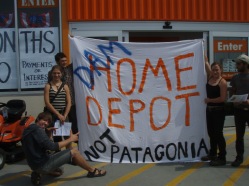
Denver, CO- Two Earth First! activists were arrested at a Home Depot last week in Glendale, CO. The arrests followed a banner being hung off the roof of a Home Depot store reading “Dam Home Depot, NOT Patagonia!” Supporters of the arrested activists demand that Home Depot cut all ties to companies involved in the HidroAysen megadam project in Patagonia.
The banner-drop action was intended to remind both the public and the company: “We’ve fought The Home Depot before and won.” Almost ten years ago, Earth First! groups around the country joined with Rainforest Action Network and others forced Home Depot to adopt wood product policies that removed old growth from their shelves. But their ongoing economic involvement with the Chilean interests that are proposing to dam wild rivers with the HidroAysen project in Patagonia shows their commitments to ‘green business’ practices to be merely empty Public Relations maneuvering. Continue reading
Amazonian Indigenous Protest Provokes Peruvian Government Reprisals
Published on Wednesday, May 27, 2009 by Environment News Service
LIMA, Peru – After more than six weeks of protests by Peru’s Amazonian indigenous groups that have included blockades of major roads and waterways and the shutting down an oil pipeline pumping station, the Peruvian government has begun to crack down.
During the past two weeks, the administration of President Alan Garcia has declared a state of emergency in the country’s Amazon provinces, issued a decree allowing the military to help the national police maintain order there, and charged the protest’s leaders with crimes against the state. Continue reading
Urbanization, Gender and Energy in World History
Introduction
In many ways, Vaclav Smil’s Energy in World History is indispensable for those wanting a better understanding of the changing relationship between human society and energy. Yet, his account is not without its shortcomings. For example, as I have addressed elsewhere, Smil neglects the role of international forces, such as imperialism, in fashioning energy use. Nevertheless, this is not the only oversight in Energy in World History. This article will briefly address how Smil also misrepresents the roles of urbanization and gender in a history on energy.
Urbanization
There is much work examining the causes and consequences of modern urbanization, and Smil does reference some of it (Bairoch 1991; Chandler 1987; Engels 1887; Kay 1832; Williamson 1982). He also recognizes the dialectical character of urbanization. On one hand, he highlights the negative ecological implications of this development. Widespread environmental degradation, Smil writes, “stems from the extraction and conversion of both fossil fuels and nonfossil energies, industrial production, and rapid urbanization. The cumulative effects of these changes can go beyond local and regional problems to cause destabilizing global biospheric change” (158). In his view, pervasive, densely-populated human settlement depends on an enormous quantity of energy, a demand satisfied with energy-dense fossil fuels, not with biomass. This makes modern urban living unsustainable. On the other hand, the massive population shift away from rural to urban areas, characteristic of industrialization, resulted in an explosion of technological and energy-saving innovations in the city (209). Nevertheless, from an energetic point of view, Smil’s evaluation is clear: “The infrastructural requirements of urban life increase average per capita energy consumption levels far above rural means even if the cities are not highly industrialized” (237). Continue reading