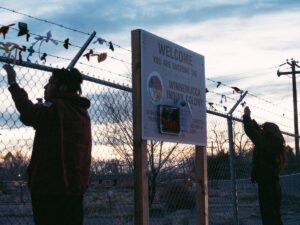
The Final Straw: Stop Evictions at Winnemucca Indian Colony

cross-posted from The Final Straw

On Tuesday, December 13th, I spoke with Kyle Missouri, a resident of the Winnemucca Indian Colony in Humboldt County, Nevada where a longstanding conflict between residents and the Winnemucca Tribal Council has come to a head recently with the evictions of elders, youths, and other residents into the snow.

Listen in.

We talk about his family’s roots in the Indian Colony, some background on the place and the conflict with the so-called Roja Council, the contested lithium mine at Thacker Pass and the court challenge to evictions, banishment and house demolition this Thursday, 12/15/22. Check our show notes for links to other sources of information, ways you can show up and places you can donate.

  • You can follow Kyle on facebook under the name Kyle Missourii (like the state with an extra ‘I’ at the end)
  • Also see interviews with Elders who’ve been evicted and updates on Instagram at @Neweneensokopa
  • Learn more about background and legal support by following Water Protector Legal Collective on social media and more at linktr.ee/waterprotectorlegal
  • And donate to the cashapp for supporting displaced families at $defendWIC. They’re looking for more lawyers who can support the efforts as well as journalists who can be on the ground and talking about this situation or reaching out for interviews.
  • You can watch the court hearing this Thursday linked in the latest update at Water Protector Legal Collective’s website, waterprotectorlegal.org
  • Kyle’s recent interview with The B&B Indigenous Podcast (appearing about an hour 8 minutes in)


Five Atlanta training center protesters charged with domestic terrorism

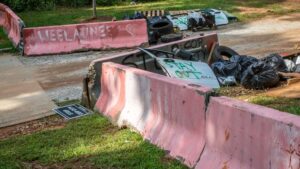
Credit: Steve Schaefer

cross-posted from EF! Journal

By Tyler Estep, The Atlanta Journal-Constitution

Five activists protesting Atlanta’s new public safety training center have been arrested and charged with domestic terrorism, the GBI announced Wednesday — one day after the latest clash between authorities and activists at planned site for the controversial development.
Dozens of arrests have been made since activists began taking up residence on the site — and engaging in more extreme actions — in an attempt to stop the training center’s construction.
But the charges announced against those arrested this week are believed to be the most serious to date.
“Yesterday, several people threw rocks at police cars,” GBI spokeswoman Nelly Miles wrote in a press release. “Task force members used various [violent] tactics to arrest individuals who were occupying makeshift [sic] treehouses.”
Those tactics included tear gas and pepper balls.
Members of  “Stop Cop City” coalition were scheduled to hold a press conference at 10 a.m. Wednesday. But DeKalb County police had access to the press conference site — a piece of former DeKalb County parkland adjacent to the training center property — blocked off [in order to prevent word of their violence reaching the general public].
Authorities  said they found “explosive devices” after Wednesday’s efforts to clear the forest. [The word of the police was taken at face value, despite them constantly making up stories to make themselves look better, because this reporter is way to lazy to actually investigate anything]
The Atlanta City Council approved last fall a land lease paving the way for the Atlanta Police Foundation to build the sprawling $90-million training facility on more than 300 acres of city-owned forest in southwestern DeKalb County.
The James M. Cox Foundation, the “charitable” arm of Cox Enterprises which owns The Atlanta Journal-Constitution, has contributed to the training center fundraising campaign. It is among several Atlanta-based foundations that have contributed.
In the year-plus since the land lease was approved, a coalition of activists — anarchists, police abolitionists, environmentalists and everyone in between — has pushed back against the concept, seeing it as the city doubling down on police militarization and other controversial tactics even in the wake of 2020?s [George Floyd uprising].
Conventional protests and opposition efforts have also taken place. But more extreme tactics have included vandalizing police property and the homes and offices of contractors tied to the training center’s construction, setting fires and throwing Molotov cocktails at police and taking up residence in the forest.

Citizen Monitors Document Damaged Roads, Felled Trees on Contested Logging Plan in Jackson Demonstration State Forest

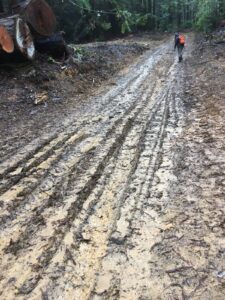
photo credit Earth First! Caption: silt runoff from logging road 359 in the Red Tail THP. Silty mud on the road measures 5 inches deep in places, the devastating result of heavy machinery work in wet weather. The fine particle mud can be seen flowing off the road down towards the Noyo River, where the silt will make the water inhospitable to salmonids and other fish species.

For immediate release

  • Dec. 14, 2022
  • Contact: Naomi Wagner (707) 502-6181, (707) 459-0548
  • Andy Wellspring (707) 367-470


Citizen Monitors Document Damaged Roads, Felled Trees on Contested Logging Plan in Jackson Demonstration State Forest

Ft. Bragg, CA-Citizen monitors were out in Jackson State Demonstration Forest (JDSF) on Monday and Tuesday this week to check on a contested timber harvest plan (THP) known as Red Tail, which they say is a prime example of the mismanagement typical of CalFire’s antiquated Management Plan. CalFire, the managing agency for the 50,000-acre publicly-owned forest both writes and approves timber harvest plans that are then put out to bid by private timber companies. Activists are calling for a complete moratorium on all logging and road-building activities in Jackson until the old management plan is replaced to address urgent issues of climate change and cultural protections.  Not only is the Management Plan inadequate, but CalFire also disregards its’ own rules, activists say.

The Red Tail monitors split into two groups each day, with one group holding protest signs at the entrance to the THP, just east of Fort Bragg off Highway 20, to alert the public to logging in the “People’s Forest.” Another group entered the THP area adjacent to the Camp One campground and the Egg Taking Station, to document alarming levels of runoff on rutted roads carrying sediment from recent rains towards the salmon spawning grounds below. Activists photographed sediment in the South Fork Noyo and reported it was “not looking too pristine” after only 2 inches of rain and 7″ season total. Many trees had been felled across a class 3 water course marked WLPZ [Watercourse and Lake Protection Zone]. Other photos showed large openings in the canopy, making a mockery of the “Old Forest Development Area” (OFDA).

“It is distressing to see that the rules governing OFDAs (Older Forest Development Areas) CAL FIRE’s Option A are being disregarded.  In the 2016 Management Plan, two continuous corridors of unbroken canopy are called for, one stretching East to West, one North to South, across the entire forest.  However, logging in the Red Tail THP, along with other THPs, has created hundreds of acres of breaks in the canopy, fragmenting wildlife habitat and increasing dryness of the forest floor,” said coastal resident and monitor, Chad Swimmer.

An “Older Forest Development Area” area is supposed to be managed by CalFire for characteristics such as large older trees and snags, connecting it to wildlife corridors. The 345-acre Red Tail THP did contain mostly second-growth redwoods and a few old growth trees before cutting reduced its numbers. Trees measuring up to five feet, or 60” in diameter have been cut.

“Taken all together, these kinds of operations – especially in the winter – create a huge disturbance in the forest. It’s a perfect picture of the usual industrial logging -just extraction – certainly not moving towards older forest development. Who would live there after the habitat is gone?” commented veteran THP monitor, Linda Perkins, referring to the plight of endangered species who need old forest habitat.”

Another citizen monitor, Andy Wellspring, said of the two days in Red Tail: “We are monitoring all THPs that CalFire has approved in this State forest. It is very saddening to see that the largest trees in Red Tail have been cut, even though they provide the most canopy, which both provides habitat for so many species and shades the forest floor and prevents fires. I urge the State to pursue equal co-management with the Coyote Valley Band of Pomo Indians immediately. These logging operations must end until equal co-management with Tribal people can restore this forest.”

Created in 1947 under a mandate “to produce high-quality timber products” alongside recreation and wildlife, timber sales provide the annual operating budget and pay the salaries of CalFire employees managing Jackson. This year, however, the State gave CalFire $10 million for “non-timber related” activities after declaring no new timber contracts would be offered. Activists would like to see CalFire buy out Willits Redwood Company’s contract on the Caspar 500, another highly contested Jackson plan.

Protests in Jackson have been non-stop since 2021, with twelve arrests for nonviolent civil disobedience, including six in Red Tail and six at the Natural Resource Building in Sacramento while protesting to protect the forest. No charges have been filed. The Coalition to Save Jackson Forest is waging a State-wide campaign to turn JDSF into a different kind of demonstration, one of equal co-management with the Coyote Valley Band of Pomo Indians, descendants of the original inhabitants of Jackson Forest, under a new Mandate based on respect, restoration and recreation and without commercial logging.

Photos:

Big trees down: photo credit Earth First! Caption: One of many log decks in the Red Tail THP in JDSF that show large trees cut in what is supposed to be the Older Forest Development Zone.

https://drive.google.com/file/d/1Xkj_prKQmz9wVssJlEomuEEGQXfgUV_t/view


muddy road:  photo credit Earth First! Caption: silt runoff from logging road 359 in the Red Tail THP. Silty mud on the road measures 5 inches deep in places, the devastating result of heavy machinery work in wet weather. The fine particle mud can be seen flowing off the road down towards the Noyo River, where the silt will make the water inhospitable to salmonids and other fish species.

https://drive.google.com/file/d/110H0H-cdrtdlYfjP5bnb9lxDyAwxvL1r/view?usp=sharing


Red Tail THP graphic:

https://drive.google.com/file/d/1rggIyZd0iLQ85nYZ91H6s51hnZlaO8vu/view


###

Blockaders Halt Border Wall Construction in Southern Arizona

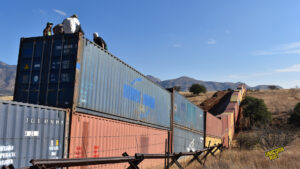
Photo: Ryan Fatica

cross-posted from Unicorn Riot

Blockaders Halt Border Wall Construction in Southern Arizona

Cochise County, AZ – Seventeen feet above the ground, towering over the native Sonoran grasses and oak saplings of the surrounding bajadas, a group of young people stretched out languidly in the sun, chatting and laughing and playing guitar. In a line to their east, the double-stacked shipping containers beneath them stretched out for over a mile; to their west, the wild grassland lay undisturbed.

On Thursday, at the southern base of the Huachuca Mountains along the U.S./Mexico border, there was little sign of the fight that had unfolded in previous days. The quiet morning stood in contrast to the international geopolitical drama unfolding through this expanse of oak grassland stretching off into Mexico.

Locals say this area is usually quiet, with no evidence of the border crisis they hear about on the news.

In the distance, the crack of a quail hunter’s shotgun disappeared into the silence.

But cutting through the otherwise pristine terrain is a gash of splotched red, blue and yellow stretching patternless through the countryside—column after column of shipping containers stamped white with serial numbers and indecipherable codes, remnants of their nautical journeys.

“They could plant one here but, we’re here,” said Carlee, a blockade participant, as she perched on the edge of a shipping container in the empty space where the next container would lay. As she spoke, she watched long, white clouds drift over the far-off mountains of Mexico.

Since Nov. 29, a loose collection of locals, environmental activists, hippies and migrant solidarity workers have been putting their bodies in the way of the machines. They have successfully delayed the work crews for a week and a half, who had been rushing to drop as many shipping containers into the wilderness as possible before Arizona Governor Doug Ducey leaves office in early January.

What began as a tentative experiment in disruption, escalated to a full-fledged encampment earlier this week. When workers switched to night shifts so they could work unimpeded, blockaders started camping on the site to keep watch.

“We would have two people on each machine trying to stop them,” said Carlee. “And they would just kind of maneuver around people and get really close. And they tried, but we stayed up all night, just making sure that they wouldn’t start moving and going down the hill to excavate more of those trees over there.”

Ary, another blockader, said that at first the workers refused to stop working despite the danger posed to those standing in their way. “At first, they were really driving their machines around us really fast,” explained Ary, as he lay among his friends atop the stacked containers. “Even just the other night, they were still doing that and digging the ground right from under our feet with their excavators, driving very close to people. I think that that just really shows how much money means to these people rather than human life.”

Thursday was the first day the workers didn’t come to the site at all. A private security guard working with the contractors remained on site, sitting in his truck and sometimes chatting casually with protestors to pass the time.

On Friday, workers reported to the site and asked that blockaders allow them to remove their heavy equipment. They loaded up the machines and drove off down the road. For now, at least, it appears the campaign has successfully shut down destruction at this site. Whether work will continue at another section of the border remains to be seen.

This is what winning looks like,” a protester commented.

“It’ll get built if no one’s standing here,” said Logan, seated atop the double-stacked containers. “At the very least we’re able to sit here and stop as much of this from occurring while whatever forces above us decide what they’re going to do.”

In Jan., Governor Ducey will be replaced by incoming governor-elect Katie Hobbs, a Democrat who has said she will remove the shipping containers when she takes office. But for his last few months in power, since he started dumping miles of shipping containers along the border near Yuma, Arizona in August, Governor Ducey’s $95 million gubernatorial swan song has raged through the mountainous terrain in Southern Arizona, destroying miles of wilderness in its path.

“This is not really even a wall,” said Ary, referring to the stack of shipping containers beneath him. “I look at it like this monument to xenophobia. It’s like art. It’s like this really, really fucked up art piece that the Republicans are making here.”

The stack of containers, which stretches through southern Cochise County, was created by AshBritt, a disaster response contractor based in Southern Florida. The company has been working under contract with the State of Arizona since at least August when they started to build a 3,820-foot long strip of double-stacked shipping containers along the border in Yuma. On Oct. 23, the company signed an additional contract with the state to begin work in Cochise County.

AshBritt conducts operations across the country in the wake of natural disasters, from Hurricane Katrina in 2005 to Hurricane Sandy in New Jersey in 2012. In 2018, AshBritt came under fire from watchdog groups and the Federal Elections Commission for an illegal donation to a pro-Trump super PAC.

Despite nearly two weeks of disruption by those seeking to block the makeshift wall, law enforcement has refused to intervene, in large part because it’s unclear what, if any, laws the blockaders are breaking. The destructive operation they are blocking is taking place on the Coronado National Forest, which falls under the jurisdiction of the federal government. The National Forest Service released a statement Nov. 30 warning visitors to the forest to stay away from the construction. According to the statement, the federal government views the construction project as “unlawful” and potentially dangerous.

Despite these proclamations, federal officials have refused to intervene—in the shipping container piling or its opposition. On Thursday afternoon, five law enforcement agents from the U.S. Department of Agriculture drove past the encampment. When approached by a camper, they identified themselves as federal agents, but said that as far as they could tell, the encampment was not in violation of any federal laws, which allow camping on national forest land.

With the feds apparently refusing to act and acres of precious wilderness at stake, people are choosing to act directly rather than waiting for those in power to sort out their tangled web of jurisdictional disputes and political power games.

“This is exciting to me because it’s one of the times that we are seeing direct action make a tangible difference in real time,” said Egg, who came down from Tucson to participate in the encampment.

The blockaders expressed a variety of reasons why they were motivated to act: concern about wildlife corridors for jaguars and other creatures, destruction of precious wilderness, government overreach, the perception that the project is motivated by racism and xenophobia, and solidarity with migrants.

“Endangered species come through here, people come through here,” said Logan, a blockader, referencing the riparian corridor of oak and juniper stretching north to south down from Miller’s Peak. “All life has moved, has migrated, historically. That’s just part of the way the world works. I think cutting it off doesn’t make any sense. It’s very disruptive to communities, both human and non-human. It’s important to keep open the free flow of life.”

“This border right here is a deep laceration of separation,” said Ary. “It is a line that makes an ‘other.’”