PODCAST: Defending Mendocino’s Sacred Sites

cross-posted from the Green and Red Podcast
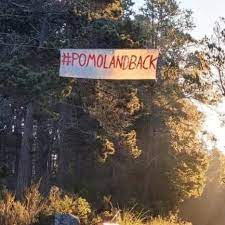
In the 1850s, the “Mendocino War” was a bloody conflict between the Yuki tribe and white settlers in Northern California. White settlers raided and stole Yuki lands and massacring hundreds of Yuki in the process. The Yuki fled to “The Mountain” in what is now known as the Jackson Demonstration State Forest to escape the violence. Those villages in the forest are now sacred sites to the Coastal Yuki and Northern Pomo tribes.

The state of California is allowing logging companies to log the 50,000 acre Jackson Forest for profit to finance CalFire’s operations fighting wildfires. Despite Gov. Gavin Newsom’s direction for California state agencies to co-manage state lands with local Native American tribes and seek opportunities to return State lands to Native American tribes, the Dept. of Natural Resources has only designated 75 acres as “sacred sites.”

Flying solo, Scott talks with Pricilla Hunter, Polly Girvin and Andy Wellspring with the Coalition to Save Jackson Forest about the ongoing campaign to save the Jackson Forest and the sacred sites within it. The campaign has seen backcountry blockades and tree-sit action as well as rallies and marches in Mendocino County and Sacramento.

Bios//
Priscilla Hunter is a Tribal Elder of the Coyote Valley Band of Pomo Indians, former Chairwoman of the Tribe, and currently the Tribal Historic Preservation Officer. Priscilla is working to protect the Sacred Sites of her Northern Pomo and Coast Yuki peoples that are threatened by logging, road building and pesticide operations in the Jackson Demonstration State Forest, which is located in her homelands, also called Mendocino County. Priscilla also founded the Intertribal Sinkyone Wilderness Council and has served as its Chairwoman for over 30 years, the Intertribal Council has secured the return of over 5,000 acres of redwood forest to Tribal people and is stewarding the land according to traditional knowledge.

Polly Girvin is a movement elder, Chicana activist, and civil rights and Federal Indian Law attorney graduated from the University of California Berkeley and Columbia University School of Law. Polly has worked with the Assembly of First Nations of Canada, and in the US helped establish the government to government consultation process with Tribes at the Federal level, including repatriation efforts for the return of ancestral human remains and sacred objects from museums and universities throughout the US. She has also been on the front lines of forest protection in Northern California for over 30 years.

Andy Wellspring is a member of Showing Up for Racial Justice, the Mendo Coast chapter. SURJ is white folks committed to racial justice nationally, and SURJ Mendo Coast is a member of the Coalition to Save Jackson State Forest and supporting the Coyote Valley Band of Pomo Indians in this struggle to protect sacred sites and end commercial logging on Pomo Homelands. Andy has worked as a community organizer in grassroots struggles, in solidarity with Indigenous people, for over a decade.

The Coalition to Save Jackson State Forest is supporting the Coyote Valley Band of Pomo Indians as they negotiate equal co-management of the Jackson Demonstration State Forest (JDSF) in their Pomo homelands.

** If you want to get involved with the Save Jackson Forest campaign: email: surjmendocoast@gmail.com.
Guardian: ‘It’s scary – things are escalating fast’: protesters fill UK streets to highlight climate crisis and cost of living

cross-posted from the Guardian

Organisers hail largest wave of simultaneous protests seen in Britain for years as people turn out in over 50 towns and cities

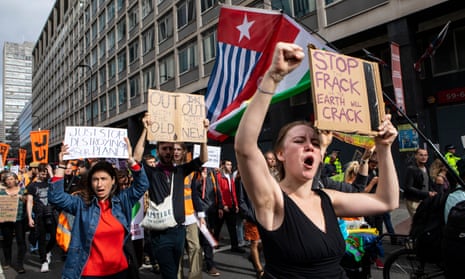
A woman in a sleeveless dress with underarm hair holds up a sign saying "Stop frack, Earth will crack" ahead of other marchers holding signs

The Just Stop Oil protest in central London on 1 October 2022 – the day regulator Ofgem’s price cap was due to rise. Photograph: Antonio Olmos/The Observer

& Sundus Abdi
1 Oct 2022 14.09 EDT

Lizzie and Dnieper are new to the protest scene. But the mounting economic crunch, cost of living crisis and climate emergency have galvanised the young family.

“It’s a little bit scary out there at the moment – things are escalating fast,” said Dnieper Cruz, 32. Turning to his daughter Lumi, almost three, the teacher added: “We just want a better future for her generation.”

His partner, solicitor Lizzie Manchester, 32, said: “It’s time for us as a family to make our voices heard.”

Around them the crowd was building rapidly outside King’s Cross station in central London, just one demonstration among at least 50 being held in towns and cities across the UK on Saturday for people to register their anger at the cost of living crisis. Organisers describe it as the largest wave of simultaneous protests seen in Britain for years.

From Eastbourne to Edinburgh, Hull to Hastings, thousands turned up at protests timed to coincide with the jump in gas and electricity unit prices that will prompt bills to soar. Social media showed large crowds at events in Glasgow, Liverpool, Manchester, Newcastle and Belfast, among others.

In Glasgow thousands gathered on the Buchanan Galleries steps for a rally and chanted: “Tories, Tories, Tories! Out, out, out!” and “The workers, united, will never be defeated.”

Coordinated among multiple community organisations and trade unions to maximise their impact, Saturday’s protests were also staged against a backdrop of the biggest rail strike in Britain for decades.

Jade Anderson holding a “We will rise – enough is enough” sign at a rally with other people standing on a low wall

‘It’s fantastic to see all the factions coming together’: Jade Anderson (centre) from Taunton, Somerset, attends the Enough is Enough rally at King’s Cross. Photograph: Andy Hall/The Observer

At King’s Cross, however, the station’s vast forecourt was crammed with protestors. Among them was Jade Anderson, 25, who had travelled up from Somerset to make the point that “enough is enough I just hope enough people mobilise for them to listen. It’s fantastic to see all the factions coming together,” she said, noting the alliance of transport unions, climate activists and social justice campaigns.

The trainee PT teacher said she was still forced to live with her parents because she couldn’t afford high rent costs.

“And the rising energy bills mean that we’re already collecting logs for the winter. My dad’s a builder and he’s putting in longer and longer shifts so we can afford to get by,” added Anderson.

The King’s Cross demo was one of at least six major demonstrations in the capital on Saturday, the combined volume of expected protestors prompting the Metropolitan police to earlier announce that it was “equally important that the rights of local residents, visitors and business owners are balanced with those who wish to protest”.

The warning did not stop climate protesters bringing the vital artery of Westminster Bridge to a standstill.

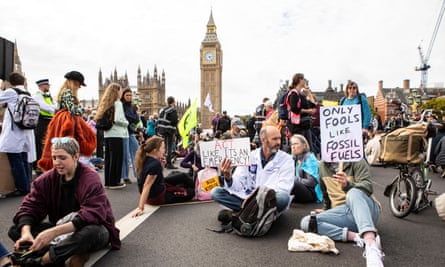
A crowd sitting on Westminster Bridge holding signs like “Only fools like fossil fuels” with Big Ben in the background

The Just Stop Oil protest at Westminster Bridge. Photograph: Antonio Olmos/The Observer

At around 2pm, dozens of activists sat on the road and played music, blocking traffic as others chanted slogans about the climate crisis.

Earlier, hundreds had also congregated outside Euston station before heading to Westminster Bridge.

The eclectic nature of those present was again quickly evident, with Just Stop Oil, Extinction Rebellion (XR) and the Revolutionary Communist Group (RCG) among the groups gathered. Some held banners denouncing capitalism “the enemy of Mother Earth”, with others protesting against the government’s recent mini-budget.

Back at King’s Cross, teaching assistant Farzana Khanom, 23, how her economic situation meant difficult choices, namely that she was having to choose between paying rising energy bills and investing in her career.

“But if we come together and make our voices heard then perhaps we can make a difference,” she said.

As she spoke, a recently launched petition calling for a general election to “end the chaos of this government” soared above 300,000 signatures by lunch.

Across the UK reports emerged of householders setting fire to their utility bills – a symbolic gesture promoted by Don’t Pay UK, a grassroots movement that has received almost 200,000 pledges from householders who are prepared to cancel their direct debits if a total of a million Britons commit to not paying.

The campaigners’ big precedent, the poll tax riots, took 4 million people refusing to pay – some of whom faced liability orders forcing them to pay – to get the government to scrap the levy.

The backdrop to the protests was the date when regulator Ofgem’s price cap was due to rise, with Liz Truss’s energy price guarantee meaning an average annual bill will be capped at £2,500 for two years from Saturday.